Case study · SharpBench · 2026
Assessed quality,
not popularity.
Agents increasingly depend on third-party services, but choosing one still means trusting reputation, a stale comparison, or a single blended score. Launched as ProviderGrade and rebranded in September 2026, SharpBench makes those tradeoffs observable and re-checkable.
- My role
- Built and run end-to-end
- Stage
- Live public product
- Scope
- Harness, tasks, scoring, API, site
- Context
- Incubated at AI Fund, with direction from Andrew Ng
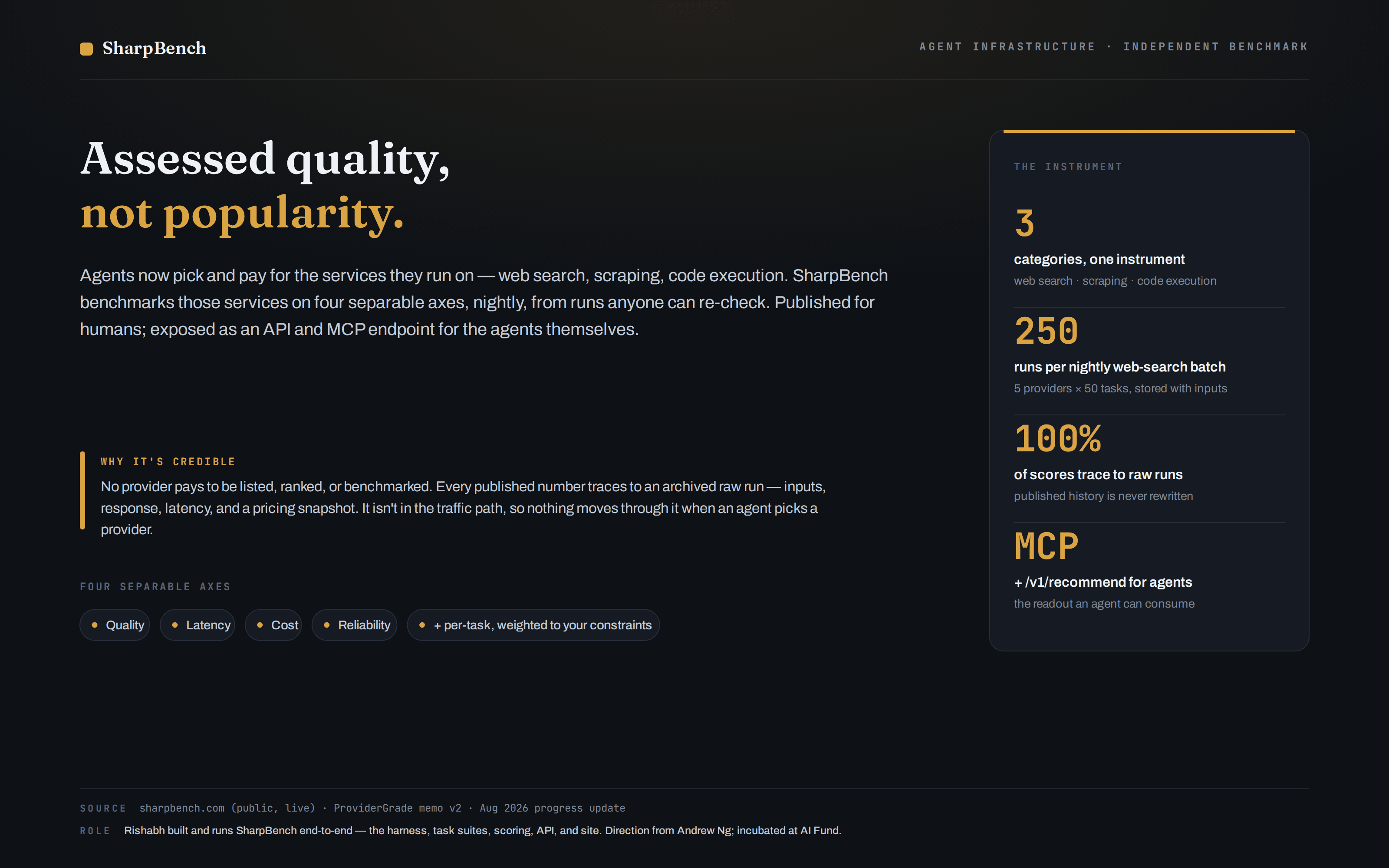
3service categories, one benchmark
250runs per nightly web-search batch
100%published scores trace to raw runs
4separate axes: quality, cost, latency, reliability
01 / The problem
A leaderboard answers the wrong question.
The best service for an agent depends on the job. A web-search provider can be excellent at multi-hop quality and still be wrong for a cost-sensitive workflow. A provider can be fast in aggregate and unreliable on the exact task that matters.
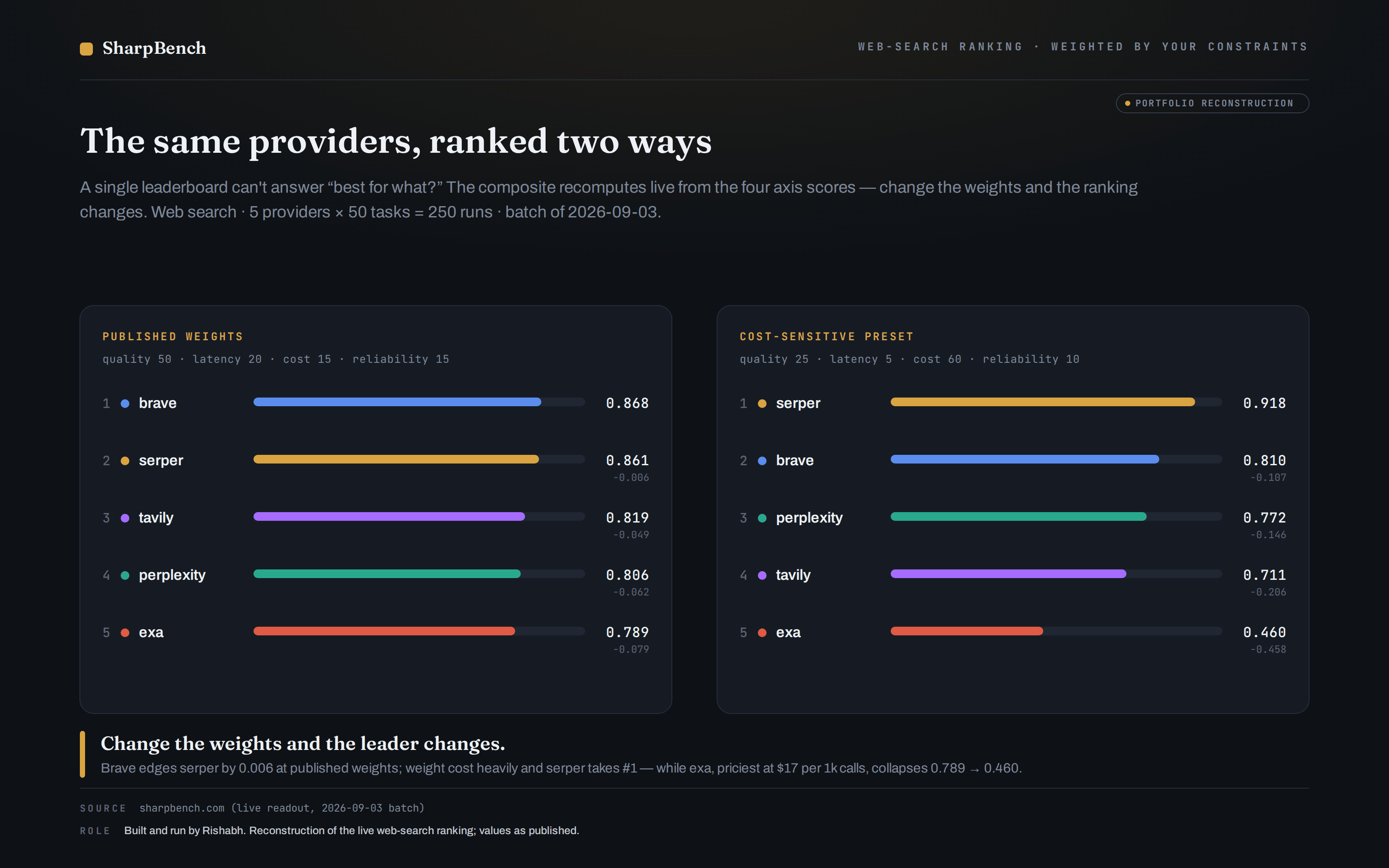
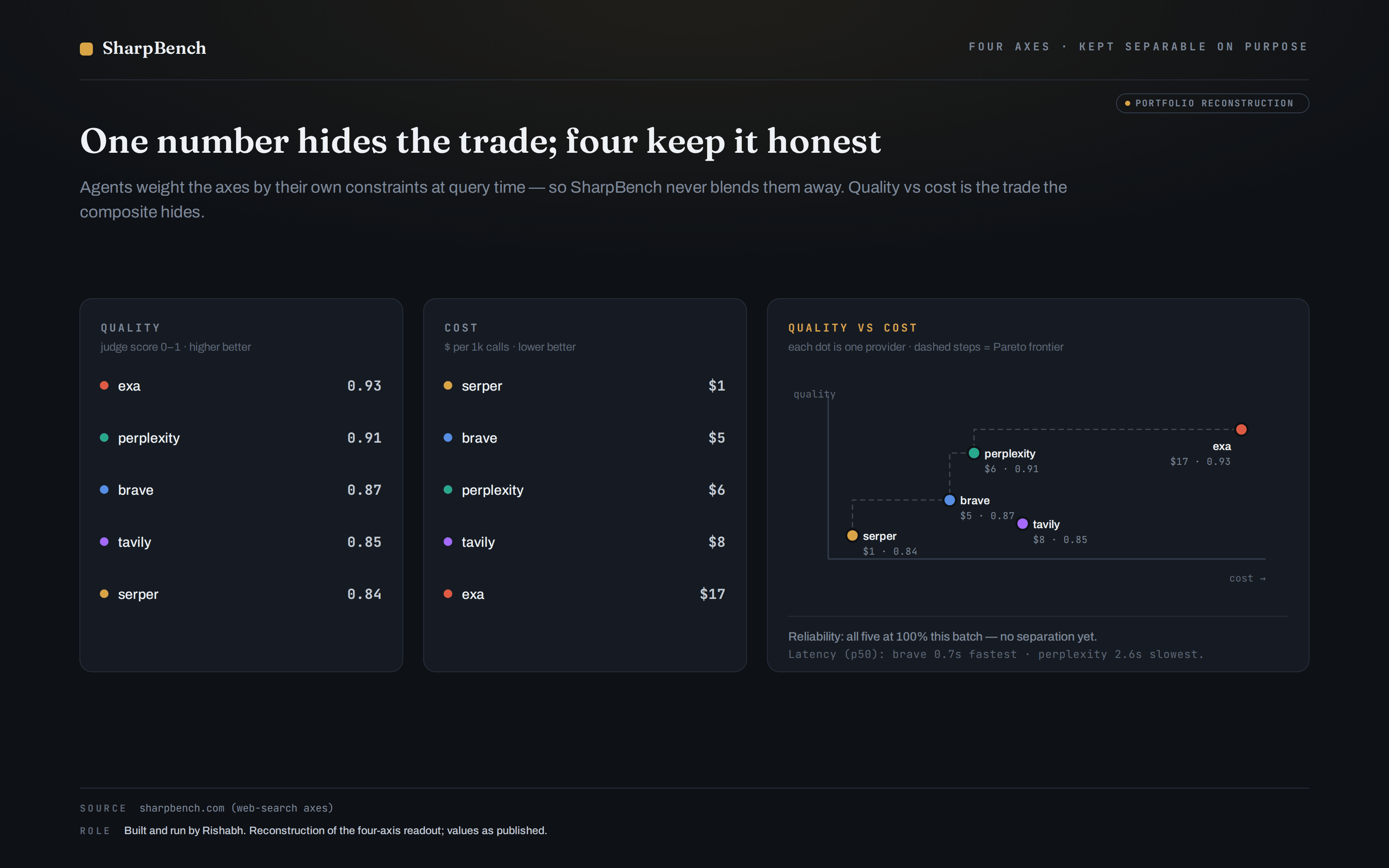
Popularity compresses those differences into a vague proxy. Even a well-measured composite score hides the tradeoffs unless its ingredients stay visible. The product thesis was simple: benchmark the services on realistic tasks, preserve each axis, and let the consumer state what it values.
Key product judgment
“One score is useful only when the tradeoffs behind it remain inspectable.”
Quality, cost, latency, and reliability remain separable. Published weights provide a sensible default; API callers can request recommendations shaped to their own constraints.
04 / Trust by design
A score should open, not end the conversation.
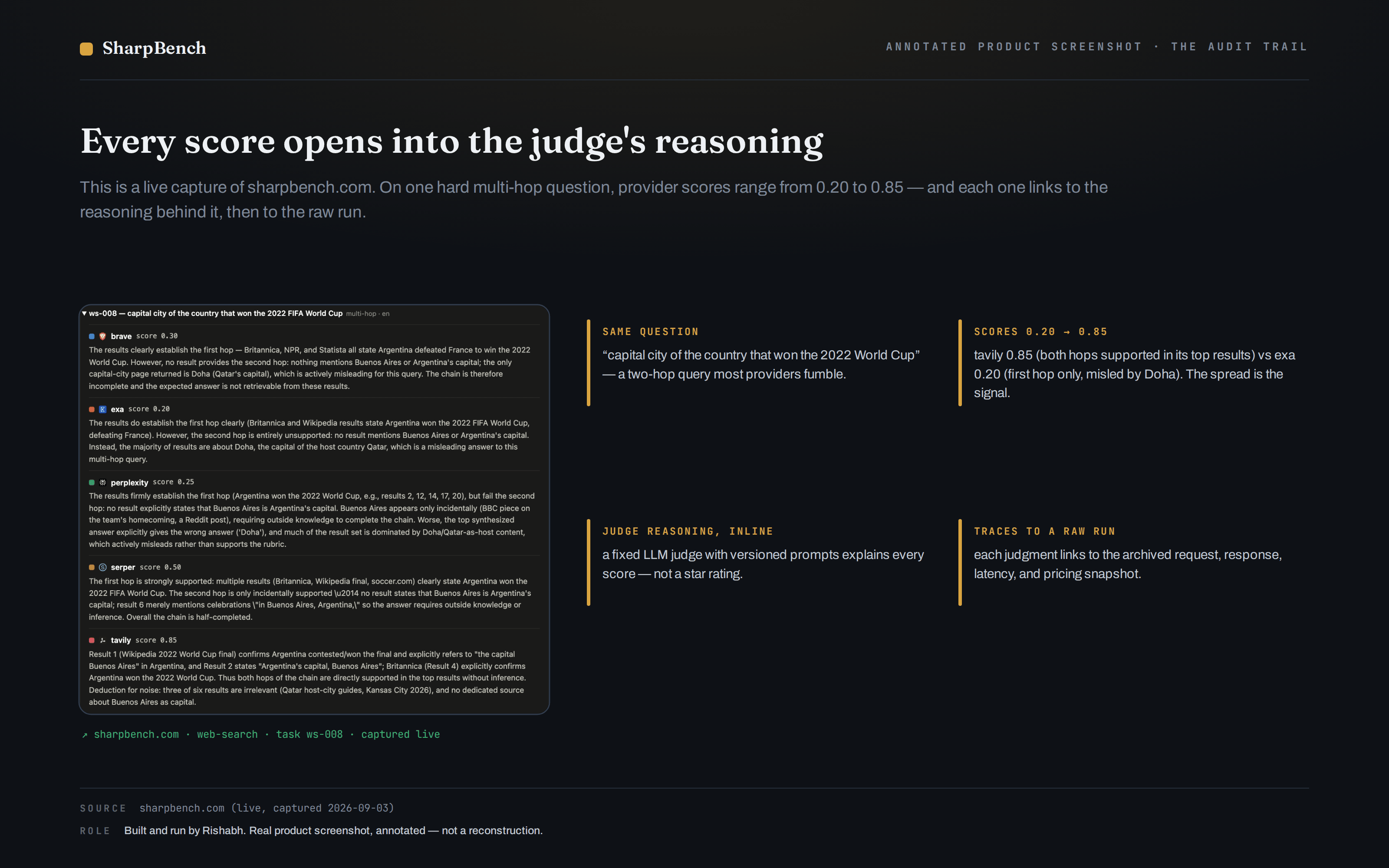
On judged benchmarks such as web search, every evaluation links to the judge’s reasoning and then to the archived request, response, latency, and pricing snapshot. The audit trail is the product, not a compliance appendix.
A fixed judge with versioned prompts makes changes diagnosable in those judged categories; code-execution quality instead uses deterministic rubric checks. Task suites make “quality” concrete, and published history is never rewritten. No provider pays to be listed, ranked, or benchmarked. The result is useful to a human comparing providers and to an agent calling the recommendation endpoint.
What shipped
From benchmark harness to an interface agents can use.
- Versioned task suites and repeatable nightly runs
- Four-axis scoring with an inspectable composite
- Archived evidence with judge reasoning or deterministic rubric results, as applicable
- An MCP surface and recommendation API for agents
- A public site for comparing providers and individual runs